Starting Later as an Artist and Why You're Not Behind
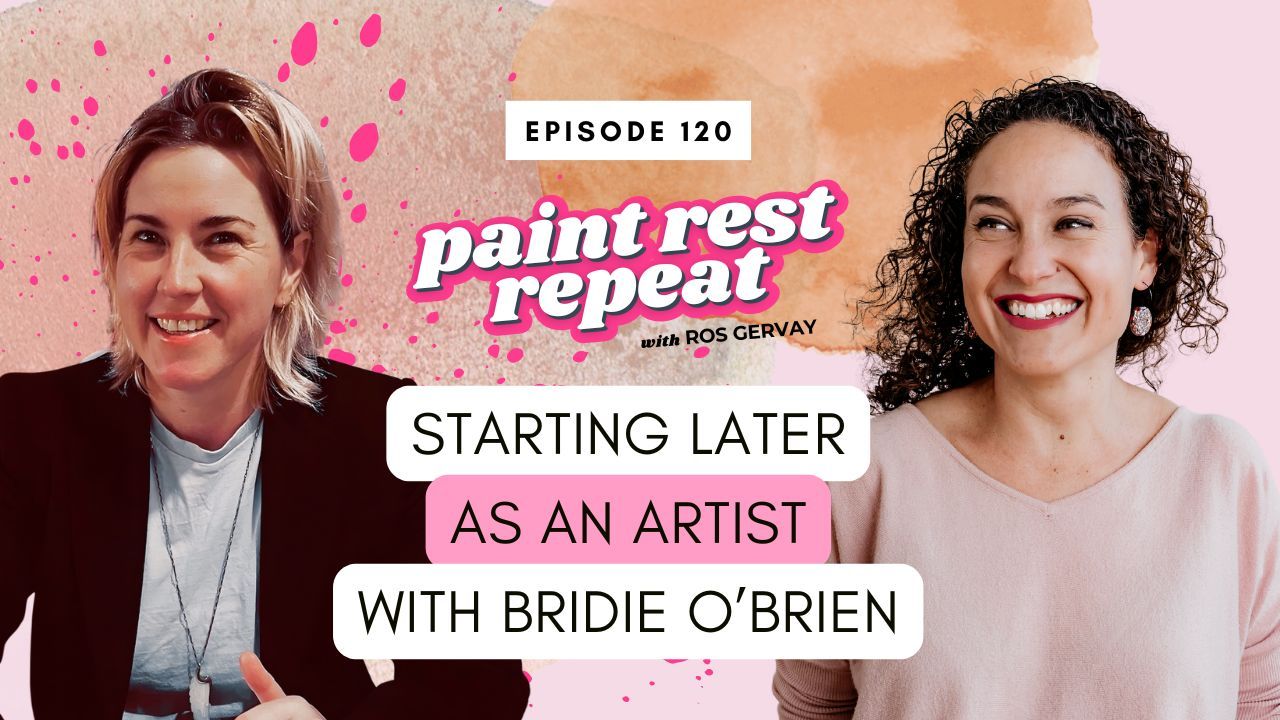
Episode 120 | Paint Rest Repeat Podcast for Artists
In a Nutshell: What if starting later is not a disadvantage but part of what makes your art stronger? So many artists carry a quiet fear that they have left it too late. Too late to take their art seriously. Too late to build a body of work. Too late to sell. Too late to call themselves an artist. Too late to begin again.
But starting later as an artist does not mean you are behind. In many cases, it means you are arriving with more life behind you — more experience, more emotional depth, more perspective, and a clearer sense of who you are.
If you take only one thing away from this post, let it be this: Your art is not separate from your life. It grows from it.
This is something that came through so beautifully in my conversation with artist Bridie O’Brien on the Paint Rest Repeat podcast. Bridie didn’t step into painting as a blank slate. She arrived with decades of creative experience behind her — music, performance, travel, technical live events, family history, and a deep relationship with landscape and feeling. Her story is such a powerful reminder that creative paths are rarely linear. And they don’t have to be.
Here for the links referenced in the episode?
Bridie on Instagram: https://www.instagram.com/hustleyourimagination
Bridie’s Website: https://www.beobe.com.au
Join us inside Art for the Heart: https://www.permissiontopaint.co/afh
Episode 120: Listen using the player below, or click on your favourite listening platform to subscribe and listen there:

You are not behind just because your path looks different
One of the hardest parts of starting later is comparison.
You might find yourself looking at artists who went to art school, started exhibiting earlier, built their audience years ago, or seemed to know from childhood exactly what they were going to do.
And suddenly, your own path can feel messy or late.
But a non-linear creative path is not a failed path.
You may have spent years doing other things. You may have worked in another industry. You may have raised children. You may have travelled, studied, cared for others, recovered from burnout, built a different career, or simply lived a life that didn’t leave much room for art.
None of that is wasted.
In fact, those years can become part of the strength of your work.
When you start later, you are not starting with nothing. You are starting with everything you have lived.
Sometimes your art needs you to live first
There is a particular kind of depth that can only come from time.
The way you see colour.
The way you notice light.
The way you respond to landscape.
The themes you return to.
The emotions that sit underneath your work.
The confidence to make decisions without needing everyone to understand them.
These things are shaped by life.
Bridie O’Brien spoke about how painting had always been present in her life, even when it wasn’t front and centre. She grew up around oil paints and creativity. Her Nana was an oil painter. Her father was a farmer, landscape painter and cartoonist. Art was always there, but it was “circling patiently” in the background while music became the main creative force in her life.
That image feels important.
Because sometimes art is not absent. It is waiting.
Waiting for a different season.
Waiting for you to trust yourself.
Waiting for life to give you the final nudge.
Waiting for you to become the person who can make the work you are here to make.
Starting later can give you creative confidence
There is a kind of confidence that often comes from having lived a few different lives.
You know what it is to begin again.
You know what it is to learn something difficult.
You know what it is to be uncomfortable and keep going.
You know what matters to you now in a way you might not have known earlier.
For Bridie, music was a huge part of that confidence.
Before she became known for her bold, intuitive landscape paintings, she had a long creative life as a musician. Music taught her discipline, performance, emotional expression, flow, and how to connect with people beyond words.
That didn’t disappear when she picked up the palette knife.
It came with her.
This is something many artists underestimate. They assume that because they are new to painting, drawing, ceramics, printmaking or selling their work, they are starting from scratch.
But you are never only bringing technical skill to your art.
You are bringing your taste.
Your instincts.
Your resilience.
Your work ethic.
Your history.
Your eye.
Your emotional intelligence.
Your capacity to notice.
Your relationship with beauty, grief, joy, place and memory.
That is not nothing.
That is the foundation.
Your previous creative life still counts
Many artists have lived creatively long before they ever called themselves an artist.
Maybe you were a musician, writer, gardener, maker, teacher, designer, performer, cook, photographer, stylist, sewer, dancer, collector, or someone who simply noticed the world deeply.
Those forms of creativity count.
They shape the way you make art now.
Bridie’s music still lives inside her painting. You can feel it in the energy of the mark-making, the unexpected colour choices, the intuitive movement, the sense of rhythm and emotional charge. Her paintings are not trying to recreate the landscape in a traditional way. They are translating feeling, memory and atmosphere.
That is what happens when one creative life feeds another.
Your earlier creative chapters are not separate from your art practice. They may become the very thing that makes your work recognisably yours.
You don’t need permission to take your art seriously
One of the most powerful parts of starting later is the moment you decide to stop waiting for permission.
Many artists wait to be validated before they act professionally.
They wait until they feel “good enough.”
They wait until someone else calls them an artist.
They wait until they have sold enough work.
They wait until their website is perfect.
They wait until their confidence catches up.
But confidence often comes after the decision, not before it.
When Bridie began painting seriously in 2020, she didn’t tiptoe in. With limited savings, she bought art supplies. She bought a professional camera. She built a website. She chose to present her work seriously from the beginning, even while she was still developing.
There is a lesson in that.
Taking yourself seriously does not mean pretending you know everything.
It means backing your own potential enough to begin properly.
It means giving your work time, space, structure and respect.
It means not treating your art like an afterthought while secretly hoping it will become something more.
Starting later does not mean moving slowly
There is a misconception that if you start later, everything has to happen slowly.
But later-starting artists often move with incredible clarity once they decide to begin.
They know time matters.
They know energy matters.
They know they do not want to spend another decade circling the thing they love without acting on it.
That does not mean rushing your development or forcing your art to become a business overnight. But it does mean you are allowed to take decisive action.
You are allowed to build the website.
You are allowed to photograph the work properly.
You are allowed to apply for the fair.
You are allowed to send the email.
You are allowed to call yourself an artist.
You are allowed to create like this matters.
Because it does.
The solitude of art-making is real
Starting later as an artist can also bring a surprising emotional challenge: solitude.
Many artists underestimate how much time a serious art practice requires alone.
In her conversation on Paint Rest Repeat, Bridie reflected on the difference between life as a musician and life as a painter. Music often came with people — gigs, community, collaborators, shared energy. Painting is different. The studio can be quiet. The decisions are yours. The doubts are yours. The discipline has to come from within.
This is why self-trust matters so much.
To keep making art, especially as a professional or emerging professional, you need to build a strong relationship with yourself.
You need to be able to spend time with your own ideas.
You need to make decisions without constant reassurance.
You need to keep going through the awkward stages.
You need to know when to seek community and when to return to the work.
Starting later can help with this, because you may already have a stronger sense of what you need to function well. You may understand your rhythms, your limits, your emotional needs and your working style better than you did when you were younger.
That self-knowledge is valuable.
Your timeline is allowed to look different
There is no single correct timeline for becoming an artist.
Some people begin early.
Some return after years away.
Some start after children leave home.
Some begin after retirement.
Some come to art after illness, grief, burnout or major life change.
Some build slowly in the background for years before making a public leap.
None of these timelines are wrong.
What matters is not whether you started at the “right” age.
What matters is whether you are willing to begin from where you are.
The artist you are becoming now is shaped by everything that came before. That includes the delays, the detours, the other careers, the quiet years, the false starts, the unfinished sketchbooks and the creative dreams you carried privately.
It all belongs.
How to start taking your art seriously now
If you are starting later, returning to art, or wondering whether you are allowed to give your creativity more space, here are a few places to begin.
1. Stop apologising for your timeline
You do not need to explain why you didn’t begin earlier. Your path is your path. The energy you spend defending your timeline could be redirected into making the work.
2. Treat your art like it matters before anyone else does
Give your practice time, space and structure. Document your work. Keep records. Share what you are making. Invest where you can. Build the foundations of the artist you are becoming.
3. Let your life experience inform your work
Don’t try to erase the years that came before. Let them feed the art. Your previous careers, relationships, landscapes, losses, skills and creative forms may hold clues to your strongest work.
4. Build creative confidence through action
Confidence rarely arrives fully formed. It grows through repetition. Make the work, share the work, refine the work, and let the evidence build.
5. Find people who understand the seriousness of your creative goals
Art-making may involve solitude, but you do not have to build your creative life in isolation. Seek out artists, mentors, communities or programs that help you stay connected, accountable and encouraged.
It is not too late
If there is one thing to take from Bridie O’Brien’s story, it is this:
Starting later does not make you less of an artist.
It may mean you are arriving with more honesty.
More courage.
More discernment.
More emotional range.
More life in your hands.
Your art has not missed its chance.
It may have been circling patiently, waiting for you to recognise that you are ready.
And you do not need to wait for perfect confidence, perfect timing or perfect circumstances to begin.
You can start from here.
If you’re ready for more personalised support in building your art business, there are plenty of ways we can work together — from self-paced courses and practical resources to memberships and masterminds. Reach out here.
Ros x
Ros Gervay is an Australian artist and creative business coach who helps artists build sustainable, income-generating art businesses without burnout or compromise. She is the founder of Art for the Heart (AFH) — an online membership community for artists at all stages — and the creator of the Thrive Mastermind, a professionalisation container for artists ready to grow beyond the learning stage. Ros hosts the Paint Rest Repeat podcast, where she shares honest conversations about the art life, creative business, and what it really takes to get paid to do what you love. Based in Australia and working with artists worldwide. Learn more at permissiontopaint.co
Frequently Asked Questions
Is it too late to start as an artist? No. It is not too late to start as an artist. Many artists begin, return to, or professionalise their art practice later in life. Starting later can bring depth, confidence, clarity and lived experience to your work.
Can I become a successful artist if I start later in life? Yes. Success as an artist is not limited to people who started young or followed a traditional art school pathway. A sustainable art practice can be built at many stages of life through consistent making, professional presentation, community, strategy and self-belief.
What are the benefits of starting art later in life? Starting later can mean you bring more life experience, emotional depth, discipline, self-awareness and clarity to your work. You may also have a stronger sense of what you want to say and what kind of creative life you want to build.
What if I didn’t go to art school? You can still become an artist without formal art school training. Many artists develop through self-directed practice, workshops, mentoring, experimentation, community, and consistent studio work. Formal education is one pathway, but it is not the only one.
How do I stop feeling behind as an artist? Start by recognising that your timeline is not meant to look like anyone else’s. Focus on the work you can make now, the skills you can build now, and the next aligned step in front of you. Your past experience is not a delay — it can become part of your creative foundation.
How do I take myself seriously as an artist? Begin by treating your art as real. Make time for it, document it properly, share it, keep records, build systems, seek feedback, and place yourself in environments that support your creative growth. You do not need to wait for external permission to start acting like your art matters.