How to Build an Art Business Around Real Life
Episode 122 | Paint Rest Repeat Podcast for Artists
In a Nutshell: Building an art business can feel like having a second full-time job—especially when you’re already managing paid work, children, caring responsibilities, relationships, health challenges or simply the everyday demands of being human.
There is always more you could be doing. More artwork to create. More content to share. More galleries to approach. More products to develop. More emails to send. More platforms to learn. And when you can’t keep up with all of it, it’s easy to assume you need to become more disciplined, productive or committed.
But the problem may not be your work ethic. You may be trying to build an art business designed for somebody else’s life. A sustainable art business doesn’t require you to ignore your circumstances. It works with the time, energy and responsibilities you actually have.
That may mean your business grows differently from somebody else’s. It may even grow more slowly. But slower does not mean less serious, less successful or less valid. It means you are building something you can realistically continue.
Here for the links references in the episode?
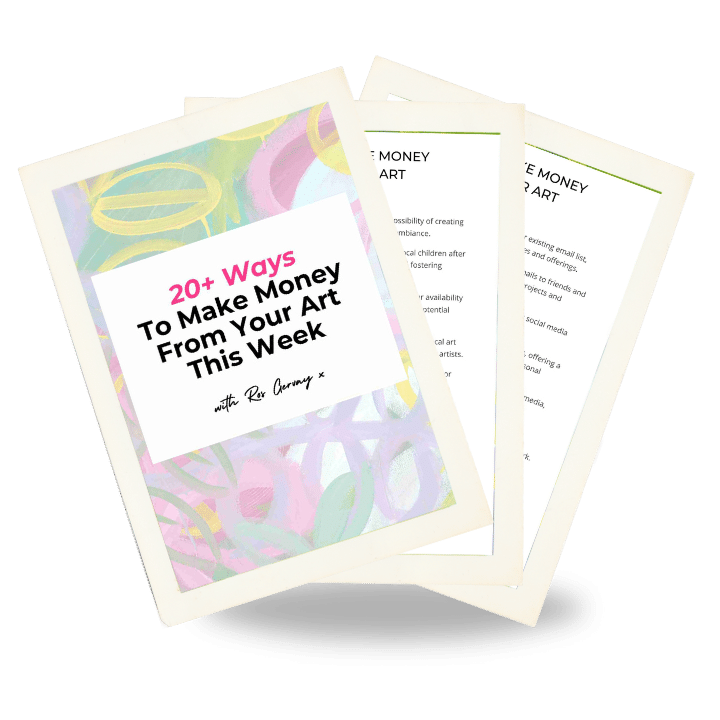
Download The Real-Life Artist’s Guide to Your Next Art Biz Move: https://www.permissiontopaint.co/art-business-guide
Episode 122: Listen using the player below, or click on your favourite listening platform to subscribe and listen there:


Your Art Business Does Not Exist in a Vacuum
It’s easy to create an art business plan as though the rest of your life will politely step aside.
You imagine consistent studio days, uninterrupted marketing time and the energy to follow through on every idea.
Real life tends to have other plans.
Children get sick. Paid work becomes demanding. Your energy changes. Family members need support. Household responsibilities expand to fill the available time.
Even during relatively calm seasons, you still need space to rest, maintain relationships and enjoy a life beyond your business.
None of this means you aren’t ambitious enough.
It means your business needs to be built on an honest understanding of your capacity.
When you ignore that capacity, even a sensible strategy can become impossible to sustain. You fall behind, lose momentum and begin blaming yourself for not being consistent.
But consistency is difficult when the plan itself is unrealistic.
Before you ask how to become more productive, ask whether the business you’re trying to build actually fits the life you have.
Stop Planning for Your Imaginary Self
Many artists unconsciously create plans for an idealised version of themselves.
This imaginary artist wakes up early, has uninterrupted days, maintains endless creative energy and never needs to answer emails, prepare dinner or recover from a difficult week.
She paints regularly, posts consistently, attends events, manages a website, builds an email list and still has enough energy to package orders beautifully.
Planning for that person may feel inspiring, but it often creates a cycle of unrealistic expectations and disappointment.
A more useful business plan begins with your current reality.
Ask yourself:
- How much time do I genuinely have each week?
- When is my energy usually strongest?
- Which responsibilities are fixed?
- What am I unwilling to sacrifice for business growth?
- What season of life am I currently in?
- What pace could I maintain for the next six months?
Your answers may be different in six months or two years.
That is normal.
Your art business is allowed to evolve as your life changes.
Available Time and Usable Capacity Are Not the Same
Time is often treated as a simple calculation.
You have five available hours, so you should be able to complete five hours of focused business activity.
But available time and usable capacity are not always the same thing.
One artist may have five uninterrupted hours during the part of the day when she feels most focused.
Another may have five scattered hours after a demanding job, while caring for children or managing unpredictable health.
Technically, both artists have five hours.
Practically, those hours offer very different possibilities.
When planning your work, consider:
- whether the time is interrupted
- how much concentration the task requires
- how physically or emotionally demanding it is
- whether you need recovery time afterwards
- how much decision-making energy you have available
This can help you match tasks to your actual capacity.
You might use your clearest hour for writing an important gallery proposal and save lower-energy periods for updating inventory, preparing packaging or organising reference images.
The goal is not to squeeze maximum productivity from every moment.
It is to use your available capacity intentionally.
Choose an Art Business Model That Suits Your Life
There is no single correct way to build an art business.
Selling art does not automatically require weekly markets, daily social media posts or constant collection launches.
Your business might focus on:
- galleries and stockists
- commissions
- online releases
- prints and products
- licensing
- workshops or teaching
- public art projects
- a small number of higher-value original works
Each model requires a different mix of time, visibility, administration, customer communication and creative output.
The right question is not, “Which art business model is best?”
It is, “Which model is most compatible with my goals, strengths and circumstances?”
An artist with young children
An artist working mainly during school hours may decide that weekend markets require too much family time.
Instead, she might focus on developing a small, cohesive body of original work and building relationships with galleries or stockists.
An artist with a full-time job
An artist with limited evenings and weekends may choose one regular creative session and one short marketing block each week.
Rather than aiming for constant releases, they might work towards two considered collections each year.
An artist with unpredictable energy
An artist managing fluctuating health may need flexible timelines and income streams that don’t depend on producing new work every week.
They might prepare email or social media content during higher-energy periods, offer prints of existing work or work with galleries that handle more of the sales process.
None of these approaches is inherently better than another.
A strong business model is one you can continue without repeatedly pushing yourself beyond your limits.
Understand the Trade-Offs
Choosing a sustainable strategy doesn’t mean every preference can be accommodated without compromise.
Every business model has trade-offs.
You can choose not to attend markets, but you will still need another way for people to discover your work.
You can choose not to post regularly on social media, but you may need to invest more energy in galleries, email marketing, networking, search visibility or in-person opportunities.
You can release new work only twice a year, but you may need another source of income between releases.
You can focus on original artworks rather than prints, but individual sales may be less frequent.
You are allowed to reject a strategy that doesn’t suit your life.
But you still need a strategy.
Sustainability is not about avoiding every uncomfortable or demanding part of business. It is about choosing demands that make sense for your goals and capacity.
Focus on the Hurdle That Matters Most
Limited time becomes even more difficult to use when every part of the business feels equally urgent.
You might spend one afternoon:
- starting a new artwork
- rewriting your website
- researching galleries
- designing a print
- posting on social media
- watching a marketing tutorial
You have been busy, but none of those tasks received enough attention to create meaningful progress.
Instead of spreading your capacity across every part of your business, identify your biggest current hurdle.
For example:
You don’t have enough finished work
Your priority may be protecting studio time and completing a focused body of artwork.
You have finished work, but few people see it
Your priority may be visibility: photographing the work, sharing it, approaching galleries or reconnecting with your audience.
People are interested, but they aren’t buying
Your priority may be improving your sales process, communicating value more clearly or following up with potential buyers.
People want to buy, but the process is confusing
Your priority may be creating a clear website, enquiry process or payment option.
Artists often respond to disappointing sales by creating more art because creating feels productive and familiar.
But if you already have 30 completed works sitting in storage, another five paintings may not solve the real problem.
The next useful move could be photographing the existing work, adding it to your website, contacting a stockist or following up with somebody who previously expressed interest.
The most effective task is not always the most comfortable task.
It is the one that addresses the hurdle currently blocking progress.
Build Through Small, Repeatable Actions
An art business is rarely transformed by one enormous burst of effort.
More often, it grows through small actions repeated over time.
One email to a gallery.
One finished artwork.
One conversation with a previous buyer.
One website update that makes purchasing easier.
One hour spent photographing available work.
These actions may not feel dramatic, but they create momentum without requiring you to overhaul your entire life.
When choosing what to work on, ask:
If I only had five hours for my art business this week, what would genuinely move it forward?
Not what would make you feel busy.
Not what everyone else appears to be doing.
What would help you:
- finish something important
- increase visibility
- strengthen a relationship
- create an opportunity to sell
Choose one main outcome.
A focused five hours can be more valuable than 15 scattered hours spent switching between unrelated tasks.
Create a Minimum Sustainable Rhythm
It can help to define the smallest version of your business routine that still creates progress.
This is not your ideal routine. It is the version you can maintain during an ordinary, imperfect week.
For example, your minimum sustainable rhythm might include:
- one studio session
- one visibility action
- one sales or relationship-building action
- 30 minutes of administration
During higher-capacity weeks, you can do more.
During difficult weeks, this rhythm gives you a simple foundation to return to.
It also prevents an all-or-nothing approach in which missing one planned task makes the entire week feel like a failure.
A smaller rhythm creates continuity.
And continuity matters more than repeatedly trying to restart an overly ambitious plan.
Measure Progress Against Your Own Goals
Comparison becomes particularly harmful when you measure your business against somebody whose circumstances, resources and goals are completely different.
The artist posting daily may have a team, childcare, fewer outside responsibilities or years of content already prepared.
The artist attending several markets each month may have a lifestyle that makes weekend work possible.
The artist releasing a large collection may have spent a year creating it.
You rarely see the full structure behind somebody else’s visible results.
Instead of measuring your progress against their output, choose indicators that reflect your own business.
That might include:
- artworks completed
- galleries approached
- returning collectors
- email subscribers
- commission enquiries
- wholesale relationships
- consistent studio hours
- revenue from a particular income stream
Your version of progress should support the business you are intentionally building.
Sustainability Is Not a Lack of Ambition
There is a persistent idea that meaningful success must involve constant expansion.
More followers. More income streams. More products. More launches. More visibility.
But growth can also mean:
- improving the quality of your work
- developing stronger relationships with collectors
- earning more from fewer sales
- simplifying your offers
- becoming more consistent
- creating more time to paint
- reducing the parts of the business that drain you
A smaller, more focused art business can still be ambitious.
A slower business can still be successful.
A business that respects your health, family and creative energy is not a compromised version of the dream.
It may be the version that allows the dream to last.
A Practical Way to Choose Your Next Move
When everything feels important, use this simple process:
- Name your current capacity
How much time and energy do you realistically have over the next week or month?
- Identify your biggest hurdle
What is most clearly preventing your business from progressing?
- Choose one useful outcome
What specific result would reduce that hurdle?
- Select the smallest meaningful action
What can you complete with the capacity you currently have?
- Repeat before expanding
Continue with the action long enough to assess whether it is working before adding another strategy.
This approach may feel slower than attempting everything at once.
In practice, it often creates more progress because your effort is concentrated rather than scattered.
Your Business Is Allowed to Fit Your Life
You don’t need to reorganise your entire life around somebody else’s version of an art business.
You get to decide how your business operates.
You can work largely within school hours.
You can choose not to attend markets.
You can focus on one or two income streams.
You can build slowly while working another job.
You can adjust your pace during difficult seasons.
These decisions may influence how quickly your business grows, but they do not make it less valid.
The goal is not to prove how much you can endure.
The goal is to build an art business you can keep showing up for—one that leaves room for your creativity, your ambitions and the rest of your life.
Sustainable does not mean unambitious.
It means creating a way forward that you can realistically continue.
Find Your Next Art Business Move
When you have limited time, knowing what to focus on can be harder than finding the time itself.
The Real-Life Artist’s Guide to Your Next Art Biz Move is a free, practical 16-page resource designed to help you cut through the overwhelm and identify what matters most in your art business right now.
It includes:
- a Focus Area Finder
- a simple five-hour action path
- a printable Art Biz Move Card
- practical prompts to help you follow through
There’s no enormous business plan, complicated strategy or hustle-culture guilt spiral.
Just a calm, realistic way to choose your next move.
Download the free guide at: https://www.permissiontopaint.co/art-business-guide
If you’re ready for more personalised support in building your art business, there are plenty of ways we can work together — from self-paced courses and practical resources to memberships and masterminds. Reach out here.
Ros x
Ros Gervay is an Australian artist and creative business coach who helps artists build sustainable, income-generating art businesses without burnout or compromise. She is the founder of Art for the Heart (AFH) — an online membership community for artists at all stages — and the creator of the Thrive Mastermind, a professionalisation container for artists ready to grow beyond the learning stage. Ros hosts the Paint Rest Repeat podcast, where she shares honest conversations about the art life, creative business, and what it really takes to get paid to do what you love. Based in Australia and working with artists worldwide. Learn more at permissiontopaint.co
Frequently Asked Questions
Can I build an art business while working full-time? Yes. You may need to work at a different pace or focus on fewer activities, but an art business can be built around paid employment. Choose a small number of high-value actions and create a schedule you can realistically maintain.
How can I grow my art business with limited time? Start by identifying the biggest hurdle in your business. Use your available time to address that hurdle rather than dividing it between every possible task. Focused action is usually more effective than trying to do a little of everything.
What is a sustainable art business? A sustainable art business is designed around your capacity, values, goals and responsibilities. Its workload and strategies can be continued without repeatedly causing exhaustion, resentment or burnout.
Do artists need to post on social media every day? No. Social media is only one form of visibility. Artists can also build audiences and sales through galleries, stockists, email marketing, search engines, collaborations, networking and in-person opportunities.
Which art business model is best for artists with limited time? There is no single best model. Galleries, licensing, commissions, online releases, teaching and higher-value original works may all suit different circumstances. Consider how much creation, communication, marketing and administration each model requires.
How many hours do I need to build an art business? There is no fixed number. What matters is how consistently and strategically you use the time available. A few focused hours spent on the right priority may achieve more than many hours divided between unrelated tasks.
Does building slowly mean I am not serious about my art? No. The pace of your growth does not determine how committed or professional you are. Building slowly can be a deliberate strategy that allows you to protect your health, relationships, creativity and long-term ability to continue.