How to Find Your Art Style: A Guide for Artists Who Feel Stuck
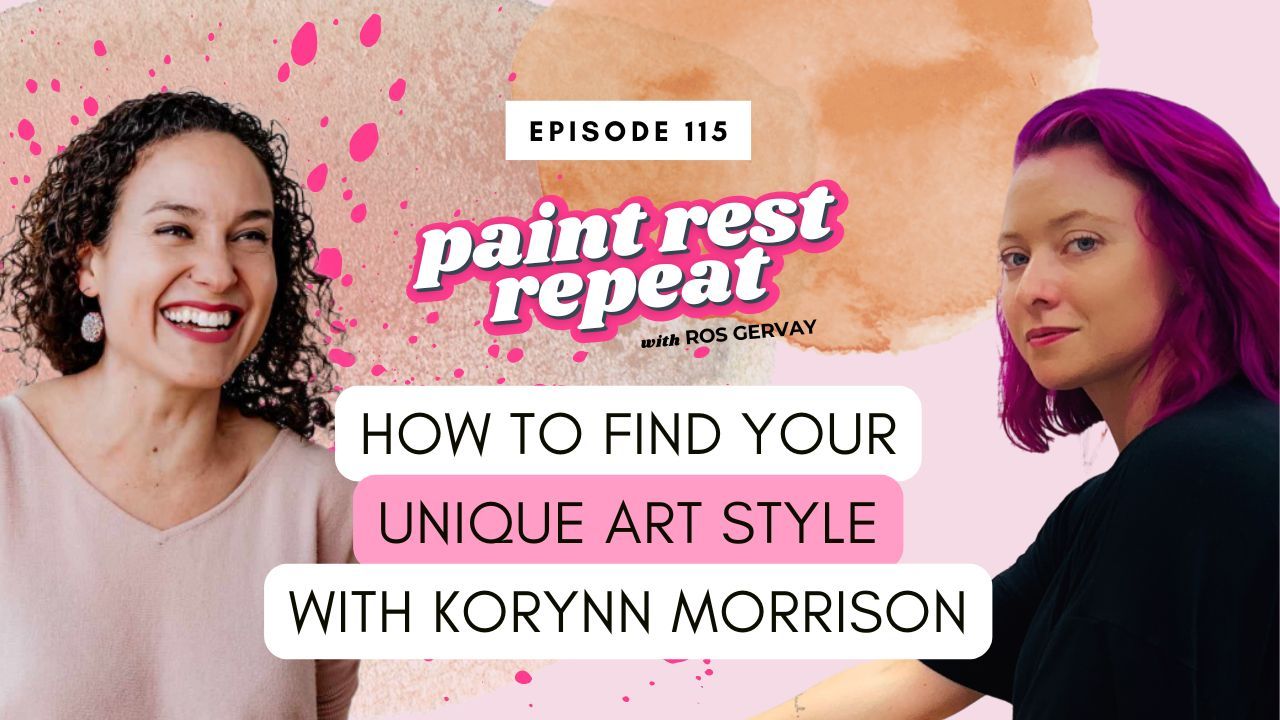
Episode 115 | Paint Rest Repeat Podcast for Artists
In a Nutshell You find your art style by making a consistent body of work, experimenting with materials and subjects, noticing what you keep returning to, and allowing your creative voice to develop over time. Your art style is not something you can fully think your way into before you begin. It becomes clearer through the process of making, reflecting, refining and repeating. If you feel stuck, stop trying to force a “signature style” and start paying attention to the visual, emotional and process-based clues already appearing in your work.
Your art style often reveals itself through:
- The colours, marks, textures and materials you naturally reach for
- The themes, memories, places or ideas you keep circling
- The processes that make you feel curious, energised or deeply engaged
- The work that feels most honest, even if it is imperfect
- The pieces that make you think, “This feels like me”
Finding your art style is less about choosing a fixed aesthetic and more about building a relationship with your work.
Here for the links referenced in the episode?
Get access to Ros' free masterclass on ‘How to Find Your Unique Art Style’ 👉 https://www.permissiontopaint.co/style
Keen to connect with Korynn? Do that here.
Episode 115: Listen using the player below, or click on your favourite listening platform to subscribe and listen there:



What Is an Art Style?
Your art style is the visual language that makes your work recognisably yours. It can include your use of colour, line, shape, texture, subject matter, materials, composition, scale, process and emotional tone. But your art style is not only about how your work looks.
It is also about what you notice, what you care about, what you are processing, and how you move through the world as an artist.
This is why finding your art style can feel so personal. You are not just choosing a technique or aesthetic. You are developing your creative voice.
Why Finding Your Art Style Can Feel So Hard
Finding your art style can feel difficult because it asks you to sit in uncertainty.
Many artists want to know what their work is “supposed” to look like before they begin. They want clarity before experimentation. They want confidence before repetition. They want a recognisable body of work before they have made enough work to see what is emerging.
That pressure can easily lead to overthinking.
You might find yourself asking:
What should my work look like?
What style will sell?
What if I choose the wrong direction?
Why does everyone else seem clearer than me?
How do I make my art look more consistent?
These questions are understandable, but they can keep you stuck in your head. The truth is, you do not find your art style by thinking about it endlessly. You find it by making the work.
You Cannot Logic Your Way Into Your Creative Voice
One of the biggest mistakes artists make is trying to logic their way into a style.
You can research, plan, analyse and compare, but none of that replaces the process of actually creating.
Your creative voice becomes clearer through action.
You have to make enough work to notice patterns. You have to make enough imperfect pieces to understand what feels true. You have to experiment enough to discover what keeps pulling you back.
Thinking can support the process, but it cannot replace the process.
If you are waiting until you feel certain before you begin, you may be waiting too long.
Clarity often comes after action, not before it.
Stop Searching for a Perfect Art Style
A lot of artists put pressure on themselves to find one perfect, finished, forever style.
But your art style is not a fixed destination.
It is a living relationship with your work.
Your style will grow as you grow. It will shift as your skills, experiences and interests deepen. It may become more refined, more consistent and more recognisable over time, but it does not need to stay frozen forever.
That does not mean your work has to be scattered or inconsistent. It means you do not need to panic every time your work evolves.
Evolution is not a problem.
It is part of becoming an artist.
Instead of asking, “Have I found my style yet?” try asking, “What is becoming clearer in my work?”
Follow What Keeps Calling You Back
Your art style often leaves clues.
You might notice you are drawn to the same colours, textures, symbols, landscapes, figures, compositions, materials or emotional themes.
You might keep returning to a particular process.
You might love a certain kind of mark.
You might feel energised by a specific subject.
You might keep circling the same ideas without fully understanding why.
Pay attention to those breadcrumbs.
Your style is often hiding in the things you cannot seem to leave alone.
Contemporary Australian artist Korynn Morrison describes this beautifully in her own practice. Her process-led “excavated landscapes” involve building up layers of paint and then sanding them back to reveal what sits underneath. The process mirrors themes of memory, imperfection, destruction and rebirth — and it emerged through years of experimentation, identity shifts and learning to follow a feeling in the work.
That is such a powerful reminder: sometimes your style is not invented all at once.
Sometimes it is uncovered.
Make More Work Than You Think You Need To
If you want to find your art style, you need volume.
Not because every piece needs to be good, but because every piece gives you information.
You learn by making.
You learn what colours you reach for.
You learn what compositions feel natural.
You learn what subjects hold your attention.
You learn what processes make you feel alive.
You learn what feels forced.
You learn what you want to keep exploring.
One painting can feel like pressure.
A body of work gives you patterns.
The more you make, the more evidence you have. Over time, you begin to see the threads.
Let Yourself Make Bad Art
This is one of the hardest but most necessary parts of finding your art style.
You have to be willing to make bad work.
Not every piece will be successful. Not every experiment will lead somewhere. Not every idea will land.
That does not mean you are failing.
It means you are gathering information.
Bad work teaches you what does not feel right. It shows you where your instincts are sharpening. It gives you contrast. It helps you recognise what is working.
If you only allow yourself to make polished, safe, pleasing work, you may never reach the interesting edges of your own voice.
Your style often develops in the messy middle — where you are trying, failing, noticing, adjusting and trying again.
Experiment Without Abandoning Yourself
Experimentation is essential, but it can also become overwhelming.
If you are constantly jumping between mediums, subjects, trends and techniques, you may feel like you are moving — but never deepening.
The key is to experiment with intention.
Instead of changing everything at once, choose one thing to explore.
Try a limited colour palette.
Work in a series.
Repeat one subject in different ways.
Explore one material for a set period of time.
Use the same size canvas for ten works.
Return to one theme and see how many ways you can express it.
Style often becomes clearer when you give yourself enough structure to notice what is emerging.
Notice What Feels True in Your Body
Finding your art style is not only an intellectual process.
There is often a physical, emotional knowing that comes with it.
You might feel more energised when you work in a certain way.
You might lose track of time.
You might feel curious instead of tense.
You might look at a piece and think, “There it is.”
You might feel a sense of recognition, even if you cannot explain it.
That feeling matters.
It does not mean every moment in the studio will feel joyful or easy. But your body often gives you clues about what feels aligned and what feels forced.
Pay attention to the work that gives you energy, even when it challenges you.
Let Your Life Inform Your Work
Your art style is not separate from your life.
Your memories, identity, challenges, grief, joy, relationships, landscape, culture, beliefs and personal history can all shape your creative voice.
Sometimes artists try to keep their work on the surface because going deeper feels vulnerable. But often, the work becomes more powerful when it is connected to something real.
You do not have to share every personal story publicly. You do not have to explain everything your work means.
But allowing your lived experience to inform your art can give it depth, honesty and emotional resonance.
Your style is not just what people see.
It is what your work carries.
Stop Comparing Your Beginning to Someone Else’s Body of Work
Comparison can be one of the biggest blocks to finding your art style.
You see another artist’s finished work, polished website, gallery representation, recognisable aesthetic or consistent Instagram grid, and you compare it to your uncertain middle.
But you are not seeing the years of unfinished paintings, failed experiments, awkward transitions, doubts, pivots and private studio moments that came before.
Every artist you admire has had to make their way through uncertainty.
No one skips the process.
Use other artists as inspiration, not evidence that you are behind.
Your job is not to become a copy of someone else’s clarity.
Your job is to keep building your own.
Work in a Series to Develop Your Art Style
One of the most practical ways to find your art style is to work in a series.
A series helps you stay with an idea long enough to understand it.
Instead of making one piece and moving on, you give yourself permission to explore variations.
What happens if you repeat the same subject ten times?
What happens if you use the same palette across multiple works?
What happens if you explore one theme through different compositions?
What happens if you let one painting lead to the next?
Working in a series helps your style become more visible because you are no longer looking at isolated pieces.
You are looking at relationships between works.
That is where your patterns start to show.
Ask Better Questions About Your Art
If you are trying to find your art style, avoid questions that create pressure or panic.
Instead of asking, “Is this my style?” ask:
What do I keep returning to?
What part of this piece feels most alive?
What am I curious to explore further?
What feels forced?
What surprised me?
What do I want to repeat?
What do I want to leave behind?
What does this work reveal about what matters to me?
These questions help you listen to your work instead of judging it too quickly.
Give Your Art Style Time to Emerge
Finding your art style takes patience.
It can be tempting to rush because you want clarity, consistency, sales, recognition or confidence. But your creative voice needs time to develop.
That does not mean waiting passively.
It means actively making, reflecting, refining and returning.
You do not need to have it all figured out before you share your work. You do not need to wait until your style is perfect before you call yourself an artist.
You are allowed to be in process.
In fact, you will always be in process.
How to Know Your Art Style Is Emerging
You may be starting to find your art style when:
- You notice recurring colours, shapes, marks, subjects or themes
- You feel more confident making decisions in the studio
- You can see connections between different pieces
- Other people begin recognising your work
- You feel pulled towards certain processes again and again
- You are less interested in copying and more interested in exploring
- Your work feels more honest, even if it is still evolving
The goal is not to lock yourself into a formula.
The goal is to recognise the thread that feels true.
A Simple Exercise to Help You Find Your Art Style
Set aside time to look at your recent work.
Choose 10 to 20 pieces, studies, sketches or experiments. Lay them out where you can see them together.
Then ask:
What do these works have in common?
Which pieces feel most like me?
Which ones feel like I was trying too hard?
What colours, marks, subjects or textures keep appearing?
What do I want to explore more deeply?
What am I ready to stop doing?
Write down what you notice.
Do not try to solve everything immediately. Just gather the clues.
Your style may already be speaking. You may simply need to listen more closely.
Your Art Style Is Revealed Through the Work
Finding your art style is not about choosing a perfect aesthetic and forcing yourself to stick to it.
It is about making enough work to discover what is truly yours.
It is about following curiosity.
It is about allowing imperfection.
It is about noticing what keeps returning.
It is about trusting the unknown.
It is about letting your life, your process and your instincts shape the work over time.
You cannot logic your way into your creative voice.
You have to make the work.
And piece by piece, layer by layer, your style begins to reveal itself.
Free Resource
If you are exploring your own creative voice, I have created a free masterclass replay on finding your unique art style. You can find it, along with my other free artist resources, here: https://www.permissiontopaint.co/resources
If you’re ready for more personalised support in building your art business, there are plenty of ways we can work together — from self-paced courses and practical resources to memberships and masterminds. Reach out here.
Ros x
Ros Gervay is an Australian artist and creative business coach who helps artists build sustainable, income-generating art businesses without burnout or compromise. She is the founder of Art for the Heart (AFH) — an online membership community for artists at all stages — and the creator of the Thrive Mastermind, a professionalisation container for artists ready to grow beyond the learning stage. Ros hosts the Paint Rest Repeat podcast, where she shares honest conversations about the art life, creative business, and what it really takes to get paid to do what you love. Based in Australia and working with artists worldwide. Learn more at permissiontopaint.co
Frequently Asked Questions
How do I find my art style?
You find your art style by making a consistent body of work, experimenting with materials and subjects, noticing what you repeatedly return to, and reflecting on what feels most true in your work. Your art style becomes clearer through action, repetition and refinement, not overthinking.
What is an art style?
An art style is the visual and emotional language that makes your work recognisably yours. It can include your use of colour, line, texture, subject matter, composition, materials, process and recurring themes.
Why can’t I find my art style?
You may be struggling to find your art style because you are putting too much pressure on yourself to have a finished style too soon. You may also be comparing yourself to other artists, changing direction too often, or not making enough work to notice patterns.
How long does it take to find your art style?
There is no fixed timeline for finding your art style. Some artists begin noticing recurring themes, colours and processes after months of focused work, while others develop their style over many years. Your art style will continue to evolve as you grow.
Can your art style change over time?
Yes, your art style can and should change over time. As your skills, interests, life experiences and creative confidence grow, your work may naturally evolve. A changing art style is not a problem; it is part of developing as an artist.
Do I need a unique art style to sell my art?
A recognisable art style can help collectors and audiences connect with your work, but you do not need to force a unique style before you begin selling. Focus on making honest, consistent work and your visual identity will strengthen over time.
How do I make my art look more consistent?
To make your art look more consistent, work in a series, limit your colour palette, repeat subjects or themes, use similar materials, and review your work regularly to identify visual patterns. Consistency comes from repetition and refinement.
Should I copy other artists to find my style?
Studying other artists can help you learn, but directly copying their style will not help you develop your own creative voice. Use other artists as inspiration, then keep making your own work, bringing in your own experiences, instincts and decisions.
What if my art looks like someone else’s?
It is normal for your work to show influences, especially while you are learning. Over time, your art will become more personal as you make more work, experiment, and allow your own themes, processes and lived experience to shape your creative voice.
How do I develop my creative voice as an artist?
You develop your creative voice by making work consistently, paying attention to what feels meaningful, reflecting on your recurring themes, and allowing your process to evolve. Your creative voice grows stronger when your work becomes more honest, intentional and connected to what matters to you.
What is the difference between art style and creative voice?
Your art style is often what people can see visually in your work, such as colour, texture, marks, subject matter and composition. Your creative voice is deeper. It includes your perspective, values, lived experience, emotional tone and the ideas you keep returning to.
How do beginners find their art style?
Beginners find their art style by experimenting widely, learning foundational skills, making lots of work, studying artists they admire, and noticing what they enjoy repeating. At the beginning, the goal is not to force a signature style but to gather experience and creative information.
How do I stop overthinking my art style?
To stop overthinking your art style, shift your focus from deciding to making. Set a simple creative constraint, such as one theme, one material or one colour palette, and create a series of works. Action gives you more clarity than thinking alone.
Is it okay to have more than one art style?
Yes, it is okay to explore more than one art style, especially while you are developing. However, if you want your work to feel more cohesive, look for shared threads across your different styles, such as recurring themes, colours, marks, materials or emotional tone.
How do I know when I’ve found my art style?
You may know your art style is emerging when your work starts to feel more connected, you notice recurring visual patterns, other people recognise your work, and you feel more confident making creative decisions. Your style may still evolve, but the thread will feel clearer.